

7/16/15
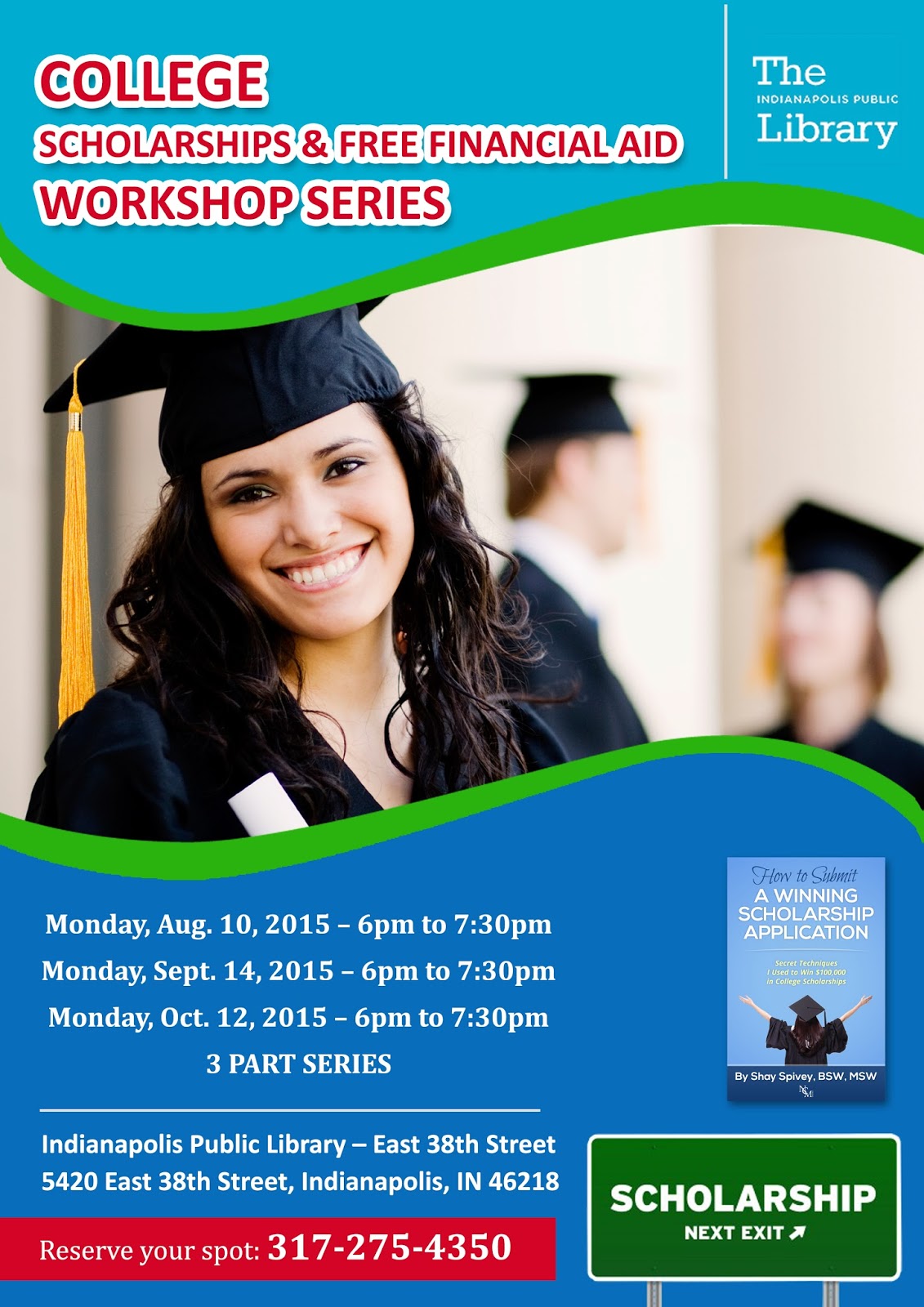
FREE Scholarship Workshop - Radio Interview
NEW Video!
7/16/2015 Radio Interview
Indy’s WIBC 93.1 and Author Shay Spivey, BSW, MSW
Author of “How to Submit a Winning Scholarship Application”

6/29/15
FREE Tuition for Seniors over 60
IVY TECH SENIOR SCHOLARS
PROGRAM
FREE TUITION

The Senior Scholars
program allows Central Indiana residents to take tuition-free courses in
Indianapolis. The qualifications are:
- Indiana resident
- at least 60 years of age
- a high school graduate or GED recipient
- retired from their primary vocation
- not employed to such an extent that my employer
considers me full-time
- complete the Senior Citizens Tuition Exemption
Certification located at the Registrar Office
- on-campus, distance education, on-line
***Scholars are required
to pay their technology fee and books.***
If someone is interested
in being a Senior Scholar they need to do the following:
- Complete the Ivy Tech Community College Application
- Complete the Academic Assessment by either taking the
academic assessment placement test or by having prior college
transcripts evaluated
- Meet with an Academic Advisor (if taking a class for
personal interest) or attend New Student Advising (if seeking an
Ivy Tech Community College Degree)
Link: https://indysecure.ivytech.edu/FAQ/afmviewfaq.aspx?faqid=1045
6/22/15
Student Loan Trap

Student loan money is easily handed over to 18-year-old college students with a wicked sneer....saying "Here little girl, do you want some candy?" or "You can have all you want little boy! Here take some more, and more, and more..."...and then the trap door slams shut *BAM*.
For example, I borrowed $3,000 of student loan money for my 2nd year of college (in 1994)...and now 20 years later I now owe $20,000. I am sure you are wondering how $3K of student loan money can turn into $20K. Well can you say subsidized? or involuntary consolidation fees? more fees? or interest accruing at a phenomenal rate? interest only payments? can you say TRAP!
Listen people! These are the facts:
- You can not file bankruptcy on student loans.
- You can not write-off student loan debt.
- You can never get rid of student loan debt except through death...
- Student loan companies can garnish your wages.
- Student loan companies can take your taxes.
- Student loan companies can haunt you for the rest of your life.
- Student loan companies will not use Vaseline (harsh but true)
I encourage everyone to exhaust all other possibilities before accepting more than your first year's salary in student loans.
For example, a Bachelor of Social Work (BSW) student should never accept $65,000 of student loan money.
A BSW will never make $65,000/yr which means a lifetime of debt. Run Forest Run! The research says that a student should only borrow up to their first years expected salary. I say... get a college degree w/out going into loan debt. Learn How to Submit a Winning College at: amzn.to/Wrnot7
6/16/15
Press Release
FOR IMMEDIATE
RELEASE:
IUPUI Social Work Alumni
Shay Spivey Debuts Second Published Book - How to Find Scholarships and Free
Financial Aid for Private High Schools
Indianapolis, Indiana Jun.
16 – IUPUI social work alumni and scholarship
expert, Shay Spivey published her second book How to Find Scholarships
and Free Financial Aid for Private High Schools, Apr. 7, 2015 with
NCM publishing group.
Shay Spivey, BSW, MSW promotes
financial access to quality education for underserved populations by helping
students understand and prepare to win scholarships for education. Spivey was
born and raised in Indianapolis, Indiana and earned her Bachelor and Master of
Social Work from Indiana University. She has studied scholarships and free
financial aid extensively and developed a passion for helping others find free
money for education. In her first book, How to Submit a Winning
Scholarship Application, Spivey shared her proven tips and
techniques that helped her win over $100,000 in college scholarships and free
financial aid toward her own undergraduate and graduate degrees.
In How to Find
Scholarships and Free Financial Aid for Private High Schools, Shay
Spivey shows families how to access scholarships and financial aid. Scholarships are a real solution and help
families address/eliminate the financial barriers that prevent access to a
quality education. How to Find Scholarships and Free Financial Aid for Private
High School is a valuable guide for families that want to know where to find
free money for private high school tuition. Inside, parents will find over 30
ways to locate, qualify for and win private high school scholarships and free
financial aid.
Shay Spivey is
available for interviews and appearances. For booking presentations, media
appearances, interviews and/or book-signings contact shayspivey@yahoo.com

6/9/15
Nursing Scholarship
Attention Nursing Majors...
The Changes Home Care $1,000 Scholarship Application is due June 30, 2015 and is being offered to Nursing + Pre-Nursing sophomore, junior or senior Students with a minimum 3.0 GPA.
Website: www.changeshomecare.com/changes-home-care-scholarship-program/
The Changes Home Care $1,000 Scholarship Application is due June 30, 2015 and is being offered to Nursing + Pre-Nursing sophomore, junior or senior Students with a minimum 3.0 GPA.
Website: www.changeshomecare.com/changes-home-care-scholarship-program/

6/2/15

Private High School Scholarships
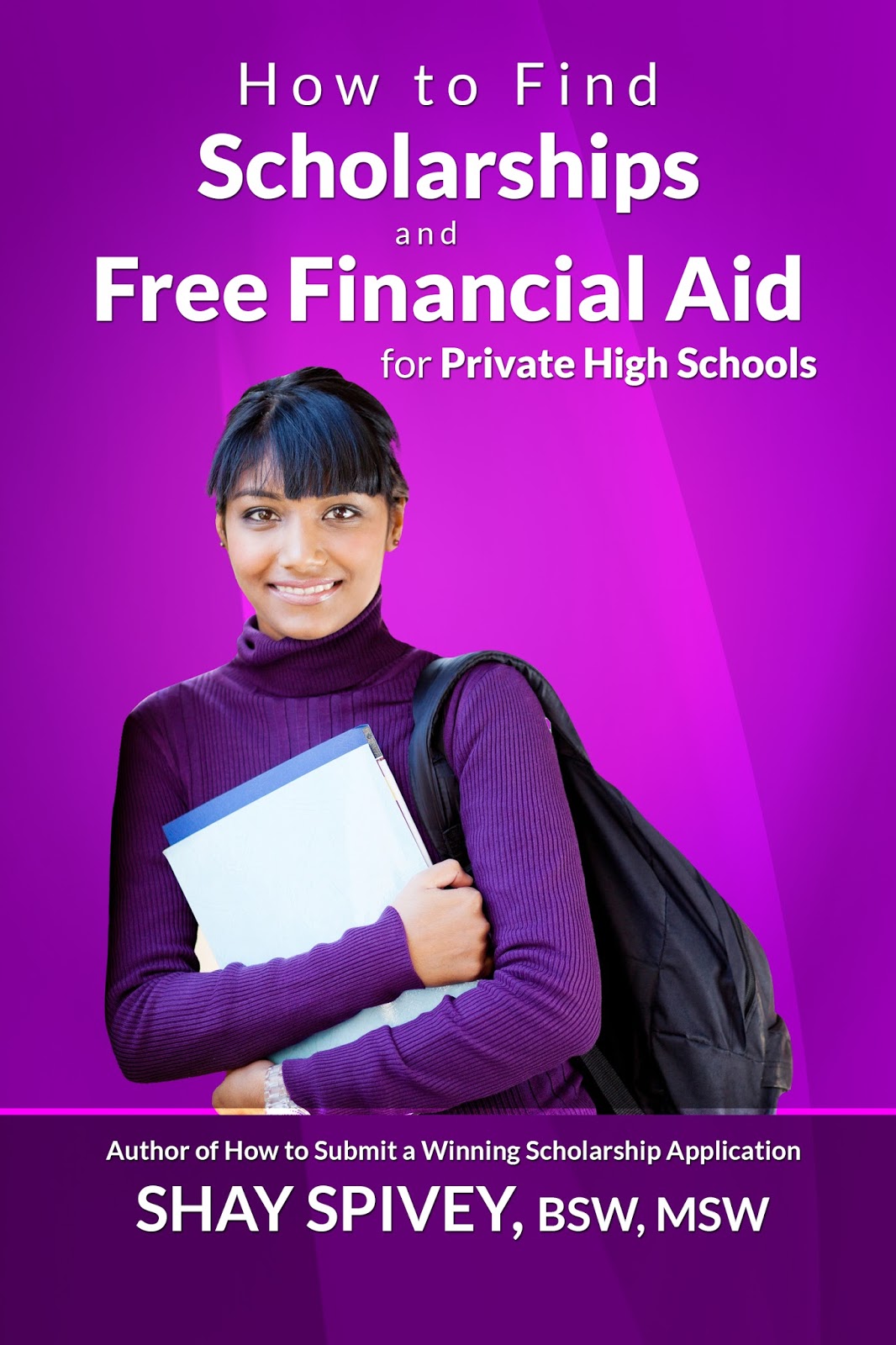
Private School Scholarships:
How to Find Scholarships and Free Financial Aid
for Private High Schools

Letters of Recommendation Tips...
• Mail a written request for a letter of recommendation. It shows that you are serious and professional about your request. An email is for reminders and verbal requests will probably not get a response.
• Ask the writer to address the letter generally to: "The Scholarship Committee". So you can use the letter for several different applications. Genius!!!!
• Be very accommodating to the people you are requesting a letter from. For example, send a resume or list of accomplishments with your written request. This way they have the information they need to write your letter of recommendation. If they have to work too hard they probably won’t write it. Remember, you know more about yourself than they do.
• Request (in writing) 3-5 original copies of the letters. Make 10-20 copies of each for each scholarship application you will submit. Some applications will ask for originals and some will accept copies. Be prepared!
• Provide your written requests well in advance. The writer is doing you a favor and good letters take time.
• You will need at least 3 letters of recommendation….so send out 9 written requests! You might actually get 3. Remember this is optional for the writer, so be very humble about reminders.
Who to ask:
• Past professors/teachers and current professors/teachers
• Employer: Manager, supervisor, co-worker, etc. Some scholarship applications specifically request a letter from your employer.
• Church: If so, ask your pastor, a minister, Sunday school teacher, etc...
• Community Service: Always request a letter when you do community service and add it to your binder/portfolio (see Prepare tab). These letters will be worth their weight in gold.
• Organizations: If you are involved with extra-curricular activities these letters will be worth their weight in gold!
Tricks of the trade: Be prepared to ask for an updated Letter of Recommendation (in writing) in November/December. You will want it to be dated for Jan. 1st or later. Most scholarship committee’s want current letters. You will be one step ahead of the game!!
Tricks of the trade: Ask for 3-4 envelopes with the original letters. Use them when the application requires a signed & sealed letter of recommendation. But black white envelopes are acceptable too.
More to Come...
5/11/15


4/10/15
Top 15 Little-Known Scholarships For Women
#1 – Executive Women International Scholarship Program: Offers scholarships to both male and female outstanding high school seniors who plan to pursue a four-year college degree program. Scholarships are based on academics, extracurricular activities, leadership and communication skills.
#2 – Linda Lael Miller Scholarships for Women: For women age 25 or older who want to complete their education. Candidates must complete a 500-word essay that explains the reasons for applying for the scholarship, how the funds will be used, and how the scholarship award will help them with their education and career goals.
#3 – Society of Women Engineers (SWE) Scholarships: For women pursuing undergraduate or graduate degrees in the areas of engineering, engineering technology and computer science. Female students must be attending accredited colleges or universities and preparing for careers in technical fields.
#4 – Joe Francis Haircare Scholarship: Named after Joe Francis (1933-1994), the founder of several hair care franchises, this scholarship is for women (and men) applying for entrance into Cosmetology/Barber School, OR actively enrolled in a Cosmetology/Barber program. An application must be submitted, as well as a one-page essay, and one or two letters or recommendation.
#5 – NFRW’s Betty Rendel Scholarship: These awards go to three female undergraduates each year who are attending a four-year accredited college or university and majoring in political science, government or economics. It is open to women across the nation.
#6 – Women’s Independence Scholarship Program: Helps women who have survived domestic violence to return to school and become self-sufficient. The primary candidates are single mothers with young children who lack the resources to attend college. It is based on financial need.
#7 – Young Women in Public Affairs Award: For young women age 16 to 19 with an interest in public affairs who plan to enroll in college. Interested students must be knowledgeable about Zonta, have experience in local or student government, and generally be active in volunteer work.
#8 – At the Well Young Women’s Leadership Academy Scholarship: These scholarships are available to help students attend a summer program at Princeton University, and is geared towards building leadership skills for minority girls entering the tenth, eleventh, or twelfth grades of high school.
#9 – Miss America Scholarship Fund: Offers scholarships to over 12,000 young women who compete in the state and local competitions as well as Miss America first place winner, four runners-up, semi-finalists and non-finalists.
#10 – Go Red Multicultural Scholarship Fund For Women: This program champions greater inclusion of multicultural women in the nursing and medical industries, address important gaps in treatment, and ensure that all Americans have an opportunity to work with their healthcare providers to make the best choices that lead to good health.
#11 – National Student Nurses’ Association Scholarships: Awarded to students currently enrolled in a nursing degree program. Eligible students must be enrolled in a state-approved nursing program that leads to a LPN or RN licensing.
#12 – Women in Federal Law Enforcement (WIFLE) Scholarship Program: Open to undergraduate, graduate and post-graduate female students interested in a career in law enforcement. Eligible students may major in criminal justice, social sciences, public administration, computer science, finance, chemistry, and physics.
#13 – Sara Scholarship: Available to female high school seniors who plan to attend college and are active in golf. The renewable scholarship is awarded to 12 deserving female students each year. Students must have excellent academic skills and demonstrate financial need.
#14 – Job’s Daughters Supreme Scholarships: Offers several different scholarships for single female students who are members of Job’s Daughters or whose parents are Job’s Daughters members. Applicants can be high school seniors, graduates or currently attending technical school or college.
#15 – Google Anita Borg Memorial Scholarship: Open to female undergraduate seniors or female students enrolled in a graduate program and studying Computer Science or Computer Engineering.
4/2/15
Buy Here
.jpg)


BarnesandNoble.com
ncmpublishing.com


IUPUI Bookstore Barnes and Noble
Indianapolis, IN
Mount Carmel Baptist Church Bookstore
9610 East 42nd Street, Indianapolis, IN
Eskenazi Health Hospital - Gift Shop
Indianapolis, IN
IUPUI Bookstore Barnes and Noble
Indianapolis, IN
Mount Carmel Baptist Church Bookstore
9610 East 42nd Street, Indianapolis, IN
Eskenazi Health Hospital - Gift Shop
Indianapolis, IN
3/30/15
Busey Scholarship

NEW Scholarship!
Deadline: April 30, 2015
Amount: $1000
Busey Community Reinvestment Act Advisory Committee Scholarship
Link to application:
http://www.busey.com/home/fiFiles/static/documents/CRA_IN.pdf
Good Luck!
3/20/15
Black Pearls Blog Tours: Intimate Conversation with Shay Spivey
Black Pearls Blog Tours: Intimate Conversation with Shay Spivey, financial ...: Intimate Conversation with Shay Spivey Shay Spivey, BSW, MSW is a scholarship and financial aid advisor specializing in helping students...
Featured Article: EDC Magazine
Check this out!
Shay Spivey, author of "How to Submit a Winning Scholarship Application",
featured on EDC Magazine - Black Pearls Blog Tours!
Article:
Intimate Conversation with Shay Spivey, Financial Aid Advisor
Article @ fb.me/1UqwOfEac

2/18/15
New Financial Aid Resource Guides
New Financial Aid Resource Guides!
Learn more at:
1.
How to Submit a Winning Scholarship Application
Link: amzn.to/Wrnot7
2.
How to Find Scholarships and Free Financial Aid for Private High Schools:
Link: www.amazon.com/Find-Scholarships-Financial-Private-Schools/dp/099157608X/ref=sr_1_1?ie=UTF8&qid=1424101056&sr=8-1

Learn more at:
1.
How to Submit a Winning Scholarship Application
Link: amzn.to/Wrnot7
2.
How to Find Scholarships and Free Financial Aid for Private High Schools:
Link: www.amazon.com/Find-Scholarships-Financial-Private-Schools/dp/099157608X/ref=sr_1_1?ie=UTF8&qid=1424101056&sr=8-1
2/6/15
Big Gap in College Graduation Rates for Rich and Poor, Study Finds
Big Gap in College Graduation Rates for Rich and Poor,
Study Finds
New Report from the University of Pennsylvania and the
Pell Institute for Study of Opportunity in Higher Education
College
completion rates are soaring among wealthy students, but there’s a disturbing
trend among students from low-income families.
By
MELISSA KORN
Updated
Feb. 3, 2015 7:53 p.m. ET
College
completion rates for wealthy students have soared in 40 years but barely budged
for low-income students, leading to a yawning gap in educational attainment
between rich and poor that could have long-lasting implications for the
socioeconomic divide.
In
2013, 77% of adults from families in the top income quartile earned at least
bachelor’s degrees by the time they turned 24, up from 40% in 1970, according
to a new report from the University of Pennsylvania’s Alliance for Higher
Education and Democracy and the Pell Institute for the Study of Opportunity in
Higher Education. But 9% of people from the lowest income bracket did the same
in 2013, up from 6% in 1970.
“Education
is one of the levers that we have in place to address income inequality. It
offers the promise of achieving the American dream,” said Laura Perna,
executive director of the Penn program. Yet the study’s findings suggest that
“education isn’t fully living up to this promise.”
One
small sign of progress is that more poor students are enrolling in college than
they did 40 years ago. Forty-five percent of dependent 18- to 24-year-olds from
the lowest income quartile—with family income of $34,160 or less—enrolled in
college in 2012, up from 28% in 1970. While the college enrollment rate of the
highest-income students—with family income of $108,650 or more—also increased,
to 81% from 74%, the gap between the two did shrink.
Still,
most of the poor students who pursue college degrees fail to make it all the
way to graduation. About one in five college students from the lowest income
bracket completed a bachelor’s degree by age 24 in 2013, about flat with the
1970 figure. Among students from top-earning families, meanwhile, 99% of
students who enrolled completed their degrees, up from 55% in 1970.
College
access has been a major area of focus for the federal government and individual
schools, with such initiatives as free campus visits and application assistance
for low-income students. The Obama administration’s fiscal 2016 budget plan
calls for $860 million to fund its major college-readiness programs, as well as
more than $300 million for GEAR UP, which targets low-income students
specifically.
But
keeping poor students on track once they’re at college remains a challenge.
That’s due in part to academic issues, since those students’ high schools may
not have prepared them for the rigors of a college course load, as well as financial
ones.
Federal
Pell Grants, which are directed to the neediest students, have been covering a
smaller share of overall college costs in recent years. While the maximum
amount, $4,690, took care of more than half the bill for average tuition, room
and board in 1974, Pell funding has remained fairly flat. In 2012, the maximum
$5,550 award covered just 27% of those expenses.
While
the report focuses on college access and completion, one thing it doesn’t cover
is whether there would be jobs for those students if everyone actually got a
bachelor’s degree, said Neal McCluskey, associate director of the Center for
Educational Freedom at the Cato Institute, a libertarian think tank.
“If
we were to get everybody through a bachelor’s degree, where in the workforce
would they be absorbed?” he asked, noting that many current college graduates
are already working in jobs that don’t require such degrees.
Link: http://www.wsj.com/articles/big-gap-in-college-graduation-rates-for-rich-and-poor-study-finds-1422997677

12/21/14
Financial Access to Education Project

PROJECT
Financial Access to Education Project
WEBSITE
Financialaccesstoeducation.blogspot.com
MISSION
Donating scholarship and financial aid guides to
under-served public high schools.

PROJECT SUMMARY
Financial aid and
scholarship education is needed in under-served public high schools.
The problem:
Many students cannot afford
to attend college but qualify for financial aid. Unfortunately, most
students do not understand the application process? Financial aid and
scholarship education is missing in our under-served public high schools.
Students know that earning a college degree would change their lives for the
better, but face major financial barriers. Students and parents
interested in attending college desperately want to understand and apply for
college scholarships but lack the guidance.
The Solution:
Now there is an
easy-to-ready guide about applying for scholarships and financial aid for high
school and college students, families, teachers, counselors and anyone
interested in learning more about free money to pay for college.
Valuable Guide:
How to Submit a Winning
Scholarship Application: Secret Techniques I Used to Win $100,000 in College
Scholarships (2014) was written by
a social worker that shares her proven tips and techniques that helped her win
on $100,000 in college scholarships and free financial aid toward her own
undergraduate and graduate degrees.
Following is the table of
contents:
- Is College Worth it?
- The Importance of Scholarships and Free Financial
Aid
- Understanding Scholarships and Free Financial Aid
- Ten Tips & Techniques for Submitting a Winning
Scholarship Application
- Technique #1 - Start Early
- Technique #2 - Get Organized
- Technique #3 - Where to Find Scholarships
- Technique #4 - The Personal Statement
- Technique #5 - Letter of Recommendation
- Technique #6 - Academic Resume
- Technique #7 – Order Your Transcripts
- Technique #8 - Follow Instructions/Meet the Deadline
- Technique #9 - Community Service and Volunteer
Experience
- Technique #10 - Always Say Thank You
- Addressing Challenges
- What to Avoid
- Resources
WHAT WE DO
Funding will go towards
purchasing and distributing books to under-served public high schools, where
they are most needed. One book will be donated to a high school library,
media center, or college resource center for use by students, families,
teachers, counselors and anyone interested in learning more about free money to
pay for college.
In addition, the book
donation will include a letter highlighting the donation and the donors.
A NOTE FROM THE AUTHOR
As a scholarship winner and first generation
college graduate, I have developed proven tips and techniques that helped me
win over $100,000 in college scholarships and free financial aid. As a proven
expert and professional consultant in my respective field, I am devoted to
helping others find, apply, and win free money to go to college. That is
why it is important to get this guide into the hands of the people who need it
the most: Students.
Response to a need
I saw a need for scholarship and financial aid
education in under-served public high schools for students in need of financial
aid to attend college. In response, I wrote a book that breaks down the
scholarship application process in an easy-to-read format. I am a new
author and a professional social worker. I work for the love of helping
others.
I wish I had this book when I was graduating
from a public high school and trying to figure out a way to pay for
college. I wish I had this book before I ever signed a student loan
contract. If I had the extra personal funds today I would put this book
in the hands of every student that needed it. That is where YOU come
in. Please help me in my effort to change the world by helping students
financially access education.
BUDGET
$1,000 from the Awesome Foundation will support 50 book donations.
$14.99 per book
$1.05 7% sales tax per book
$3.99 Shipping and handling
per book
Subtotal = $20.03 book
donation
12/15/14
Wealth Gap Widens
Question:
Why are #Minority #Scholarships important?
Answer:
Massive wealth gap between whites and other racial and ethnic groups has reached record levels.

________________________________________________________________
Link: money.cnn.com/2014/12/12/news/economy/wealth-by-race-pew/
The Great Recession hit all Americans hard, but only whites have seen their wealth rise during the recent recovery.
And that's widening the already massive wealth gap between whites and other racial and ethnic groups to near record levels.
White households' median wealth ticked up to $141,900 in 2013, up 2.4% from three years earlier, according to a Pew Research Center report released Friday.
Net worth for black households dropped by a third during that time to $11,000. Hispanic families experienced a 14% decline in wealth to $13,700.
Whites have 13 times the net worth of blacks, the largest wealth gap that's existed since George H.W. Bush was president in 1989. The ratio of net worth between whites and
Hispanics now stands at more than 10, the widest it has been since 2001...
12/6/14
2014 Indianapolis Recorder Article
Link:
http://www.indianapolisrecorder.com/education/article_754cd212-7bc5-11e4-9429-3378c3f36fb8.html#.VIMXoYEor9s.twitter

Indianapolis Recorder
Thursday, December 4,
2014
Indy native nets $100K in college
scholarships
More than five years ago, Shay Spivey of Indianapolis juggled two
young children and a low-paying job with very little opportunity to advance.
She desired to return to college to earn a bachelor’s degree after
failing to complete her program several years ago following high school.
However, every employment position she desired required a college degree, which
Spivey knew she couldn’t afford at the time.
After countless hours of research she was awarded over $100,000 in
scholarships to continue her education. Today Spivey holds a bachelor’s and
master’s degree and works as a mental health and addictions counselor.
Recently, she released her book, "How to Submit A Winning
Scholarship Application - Secret Techniques I used to Win $100,000 in College
Scholarships" and the Indianapolis Recorder Newspaper got a chance to chat
with her about her scholarship journey.
What was your initial purpose of seeking scholarships?
Were you in a financially unstable situation or were you simply
looking for alternative ways to pay for your higher education?
For me it was no money, no college. Honestly, my situation was
being a single parent and working at a low income job. I really wanted to get
my degree. I felt stagnant, going nowhere with no opportunities.
How did your search process begin?
With two kids and finance issues, I knew paying out of pocket
wasn’t an option so I started researching. I used to spend my lunch break at
the library and I always had a book in my hand. As I started reading I realized
I truly didn’t know much about scholarships. I started a year in advance and
said I was going to give it my all.
Did you believe you would be rewarded more than $100,000?
No, I had no idea and was awarded the money over a course of time.
I always encourage people to not skip over the small scholarships. The smaller
ones are worth it too and add up. Most people look at those and think they
aren’t worth their time so as a result; many people aren’t applying for them. I
had quite a few $500 scholarships but a secret I talk about in the book is
maintaining a relationship with scholarship organizations. Some key
organizations gave me money year after year.
What type of effort and time did it take?
I treated it like a part-time job in the evenings. Eventually I
had to map out time because I was in school but needed to begin preparing for
the following year. As I got going it was an hour in the evening five days a
week. A lot of my scholarships were community service scholarships and many
were based off of philanthropy and giving back.
What are some of the misconceptions of applying for scholarships?
The biggest complaint is writing an essay. The way I encourage
individuals is by telling them “The essay is about you and nobody can tell your
story better than you. It’s your thoughts, your hopes and your dreams.” You
need to be able to explain to someone in writing what’s in your head and your heart
and why you want to go to school. It’s encouraging and motivating. That writing
piece is how they get to know you.
Throughout your research process you’ve gained money to further
your education, how do you plan to give that back to the community?
My goal is to help families and individuals go to school without
acquiring serious student loan debt. The challenge is, many aren’t taught
anything about scholarships and if parents didn’t attend college, it’s hard to
teach their kids about scholarships. I read an article that said there is 9
billion in state money for students to go to college. I want to connect people
with that money. Education is the key out of poverty.
When did the idea for a book develop and what should readers
expect?
I started a scholarship advisor program in 2009 that started off
as a blog. The book came because I was giving people one-on-one attention but I
wanted to reach a broader audience. I want my community to have access to that
9 billion dollars and learn how to navigate the scholarship system. My goal is
to not only help young students but those like me who have children. I knew for
the first time in my life I was on the right path because everything fell into
place and it wasn’t hard.
For more information about Shay Spivey and her book “How to Submit
a Winning Scholarship Application,” visit amazon.com or follow her on Twitter @ShayMSpivey.
Subscribe to:
Posts (Atom)